The 12 Most Common Questions from Attorneys and Paralegals About Court Reporting — Answered by PRI Court Reporting

The 12 Most Common Questions from Attorneys and Paralegals About Court Reporting — Answered by PRI Court Reporting

For more than 45 years, PRI Court Reporting has been trusted by law firms, corporations, and courts across Ohio and the Midwest for precise, professional, and reliable record-taking. Over the years, we’ve heard many of the same questions from attorneys, paralegals, and clients — about our process, our technology, and what makes this profession so vital to the justice system.

We’ve gathered the answers to the most frequently asked questions about court reporting — drawn from our experience and expertise. Whether you’re a longtime client or simply curious about what we do, this guide offers a behind-the-scenes look at the work we do that ensures every word counts.


1. Is Court Reporting Being Replaced by Artificial Intelligence?

While technology supports our work, it cannot replace it. AI lacks the context, accuracy, and impartiality that certified court reporters provide. At PRI, we use technology to enhance our service — never to replace the human expertise that defines it.


2. What’s the Difference Between a Stenographic Court Reporter and a Digital Court Recorder?

A stenographic court reporter captures testimony live, in real time, using a stenographic machine or voice-writing equipment. A digital court recorder typically records the proceedings and after the proceedings, a transcriptionist produces a transcript from the recording. Every PRI transcript is produced and certified by a trained stenographic court reporter — ensuring it’s admissible, accurate, and complete.


3. Is There a Shortage of Court Reporters?

Not necessarily a shortage, but as veteran reporters retire, the demand for skilled reporters continues to rise nationwide. It’s one reason PRI invests in supporting and retaining experienced professionals. Our clients benefit from PRI’s longstanding relationships and reputation for stability.


4. How Long Does It Take to Get a Transcript?

Turnaround times depend on your needs. PRI offers standard delivery for most transcripts, which is 10 business days, along with expedited and daily copy services when time is critical. Every transcript is reviewed for accuracy and formatted to our transcript specifications — ensuring quality never takes a back seat to speed.


5. What Is Realtime Reporting?

Realtime reporting allows attorneys to view the transcript as it’s being written — word for word — during the proceeding. It’s invaluable for strategy, review, and note-taking. PRI’s Certified Realtime Reporters provide this service seamlessly, both in person and remotely.


6. Do You Offer Remote or Hybrid Depositions?

Yes. PRI was among the first in Central Ohio to adopt secure, reliable remote deposition technology. Whether your case involves local witnesses or participants across the country, our team handles every detail — from virtual exhibits to realtime streaming — with the same professionalism you expect in person.


7. Can I Get a Rough Draft Transcript the Same Day?

Absolutely. When strategy can’t wait, PRI offers rough drafts delivered within hours of your proceeding. Our reporters use advanced realtime software to assist in producing accurate drafts quickly, allowing you to review testimony and prepare for the next day’s session with confidence.


8. Do You Provide Videography or Legal Video Services?

Certainly.  PRI can schedule legal videographers who work seamlessly alongside our court reporters to create a synchronized record of both testimony and demeanor. We also provide video-text synchronization for trial presentation, formatted to your specifications.


9. Are Your Court Reporters Certified?

Yes, PRI’s reporters are highly trained and experienced professionals holding state and national certifications such as Registered Professional Reporter (RPR), Registered Merit Reporter (RMR), and Certified Realtime Reporter (CRR). We also have reporters certified in California, Illinois, and Michigan.  Certification ensures our reporters meet the highest standards for speed, accuracy, and ethics.


10. How Does PRI Handle Depositions That Run Long or Get Rescheduled?

We understand that legal proceedings can change quickly. Our scheduling team remains flexible and responsive, adjusting to extensions, cancellations, or new start times with professionalism and courtesy.


11. How Can I Schedule a Deposition with PRI?

We make scheduling simple. You can schedule online at priohio.com, call our scheduling team, or email directly. Whether your proceeding is in person, remote, or hybrid, PRI coordinates every detail so you can focus on your case — not logistics.


12. Why Choose PRI Court Reporting?

Because experience matters. For over 45 years, PRI has partnered with attorneys, firms, and courts who value reliability and excellence. From realtime reporting to secure file management, we provide complete, client-focused solutions tailored to your needs.  Every transcript, every proceeding, every client receives the full measure of our attention and expertise. We’re not just capturing words — we’re preserving accuracy, trust, and the integrity of the record.


Closing Thoughts

Court reporting is more than a profession — it’s a commitment to the preservation of the legal record. At PRI, we’ve built our reputation on that commitment for over four decades. Whether you’re an attorney, paralegal, or client, you can count on us to deliver clarity, confidentiality, and excellence on every page.

PRI Court Reporting — Experience. Precision. Integrity.
Visit us at priohio.com to schedule your next proceeding or learn more about our services.

Protect Your Client. Protect Your Record.

Protect Your Client. Protect Your Record.

Can we have a word?

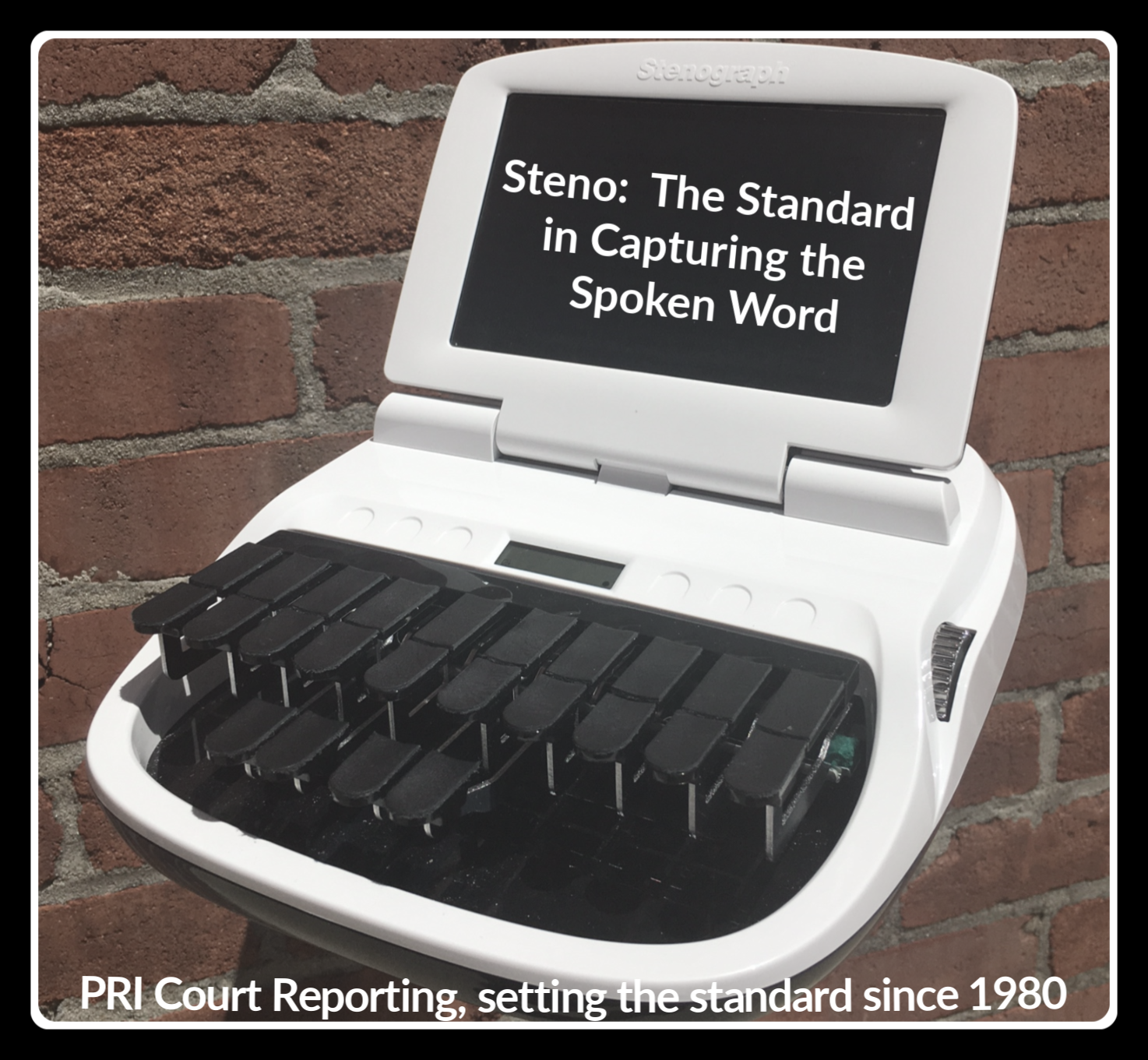
You may be receiving marketing materiSteno machine standardals and sales pitches from national court reporting firms about alternative ways to preserve testimony at your depositions, namely “digital reporting.”  They are suggesting you change the language of your deposition notices to “broadly reflect variable methods  of capture.”  Perhaps you haven’t heard a thing about this yet.  Either way, it’s important that you are fully aware of some of the complications of this emerging practice.

These national firms are suggesting that digital reporting at a deposition is comparable to having a stenographic reporter present at the deposition.  They are suggesting that a shortage of stenographic court reporters has created a need for this alternative method of preserving testimony.  They are suggesting that this will assure you coverage for your depositions.  We disagree with this stance and we feel very strongly that the stenographic profession is strong, very capable, and committed to the service we provide to the legal community.

While we are not seeing these challenges in the Ohio area yet, there are cities across the country where attorneys that are required by their client to use these large firms (an issue for another day!) are facing the challenge of getting their depositions covered with stenographic reporters, thereby having to reschedule or cancel them.   There are several reasons some of these national firms have trouble finding court reporters to cover these jobs, including low rates to the court reporter due to contracting with insurance companies and corporations.

As a local, court reporter-owned firm with over 30 years of experience, we want to make sure you have enough information to understand the complexities of this situation if you’re ever faced with it, either in Ohio or when traveling to other cities for depositions.

In the states that have court reporting certification and professional standards, such as California and Texas, having a digital “reporter” present at a deposition could jeopardize your record, your case, and your relationship with your client.  In California, stenographic reporters are licensed by a board in the same state department that regulates CPAs, physicians, and other professionals1.  They are subject to discipline by that board for their conduct.   Machine operators or digital recorders are not trained, certified, or regulated in any way by the state.

According to the Deposition Reporters Association of California, when you agree to utilize a digital reporter for your deposition in California, you run the risk of the following:

Here are just a few advantages of having a stenographic reporter over a digital reporter, regardless of where your deposition is held:

The bottom line here is that there are still many qualified, certified stenographic court reporters available for depositions across the country.  Don’t let the national firms scare you into changing your deposition notice language to include “digital audio equipment or any other alternative means of capture.”

Choose a licensed or certified stenographic court reporter for your record every time.  If you’re traveling to other cities or states for your deposition, be sure to request a “stenographic court reporter” when scheduling with your chosen court reporting firm.  If you ask for a certified stenographic court reporter (whether certified by the state or NCRA), you can be assured you’ll receive a quality transcript, which is exactly what you and your client deserve.

ABOUT THE AUTHOR:

Angie Starbuck, RDR/CRR/CRC is a court reporter in Columbus, Ohio, and the owner of PRI Court Reporting, LLC. Connect with her on LinkedIn.  You can also follow PRI Court Reporting on Twitter and Facebook.


1Deposition Reporters Association of California, Inc., www.caldra.org

2There are many, many examples of malfunctions. Here is an excerpt from a 2012 case in New York involving a prisoner: “[t]he petitioner’s transcriber documented numerous and lengthy gaps in the hearing tape, which rendered much of the transcript unintelligible. Based upon the foregoing, the Court found that the condition of the transcript was such that it, indeed, precluded meaningful review of the disciplinary determination.”

3CCP section 2025.340(m): “ … If no stenographic record of the deposition testimony has previously been made, the party offering an audio or video recording of that testimony under Section 2025.620 [impeachment] shall accompany that offer with a stenographic transcript prepared from that recording. (Emphasis added.) “Audio or video recordings made by the parties or by the deposition reporter … are not considered recordings of the proceedings. Only the stenographic transcript qualifies” ]Weil & Brown, Cal. Prac. Guide Civ. Pro. Before Trial Ch. 8E-14, The Rutter Group,(June 2018), Chapter 8. Discovery, Chapter 8E. Depositions, 14. [8:766], “If the testimony is recorded stenographically, it must be recorded by a certified shorthand reporter.” Serrano v. Stefan Merli Plastering Co. (2008) 162 Cal.App.4th 1014, 1033

Download the Deposition Scheduling Checklist

  • This field is for validation purposes and should be left unchanged.

Court Reporting Ethics: Incentive Gifts to Attorneys

Court Reporting Ethics: Incentive Gifts to Attorneys

Does your court reporting firm offer you, your assistant, or your paralegal, gifts of money, gift cards, or products in exchange for scheduling your depositions with them?  Over the years, some court reporting firms have participated in a disturbing practice of offering “rewards programs” for attorneys and their law firms whereby the scheduler of depositions earns points or gifts every time they schedule with that court reporting firm.

This can be a dangerous practice for court reporting firms as well as the attorneys and their clients.  As keepers of the record and officers of the court, court reporters should maintain impartiality and neutrality in order to protect the integrity of our profession.

The National Court Reporters Association (NCRA) Code of Professional Ethics states that members shall, “Refrain from giving, directly or indirectly, any gift or anything of value to attorneys or their staff, other clients or their staff, or any other persons or entities associated with any litigation, which exceeds $150 in the aggregate per recipient each year.  Nothing offered in exchange for future work is permissible, regardless of its value.”  NCRA has further distinguished between “thank you” gifts (such as pens, coffee mugs, and other marketing materials), and “incentive” gifts, which are given in exchange for the promise of future work.

NCRA has formed Ethics First, which is a “voluntary…public awareness program that seeks to positively educate court reporters, colleagues, firms, and in particular, their clients and consumers,” about why the impartiality and neutrality of the court reporter is so important in maintaining our legal system.  If you would like to help maintain an unbiased legal system, please consider using a court reporting firm that is an Ethics First member, and one that doesn’t use gifting as a way to increase their business.

While the court reporter’s concern about impartiality is of utmost importance to them, attorneys and law firms should also be concerned about their participation in “rewards programs.”  Here are some things to think about:

So when scheduling your depositions, whether locally or nationally, don’t hesitate to ask the firm if they are an Ethics First participant.  Consider using a firm with qualified, experienced court reporters so you know you’ll receive the best services for your client, and don’t be fooled by the gifts!


ABOUT THE AUTHOR:

Angie Starbuck is a court reporter in Columbus, Ohio, and the owner of PRI Court Reporting, LLC. Angie is an individual participant in NCRA Ethics First, and PRI Court Reporting is a proud Ethics First firm participant.  Connect with her on LinkedIn and Google+.

Photo credit here.

Download the Deposition Scheduling Checklist

  • This field is for validation purposes and should be left unchanged.


Video Deposition Tips for Attorneys and Their Witnesses

Video Deposition Tips for Attorneys and Their Witnesses

Video depositions can be very helpful to your case and they are sometimes even necessary to be used during trial.  For these reasons, it would be to your benefit to make sure you get the best quality video you can.  Here are a few key things court reporters and videographers have learned over the years that will help with this and hopefully keep your video off YouTube with the search term “worst video deposition”!

1.  Reserve a conference room with adequate space to accommodate all the parties and the addition of a videographer and his/her equipment.

2.  Make sure all parties are aware the videographer will need access to the conference room one hour prior to the start of the deposition so they can set up and test all equipment.

3.  The sound quality is best when the microphone is placed in the center of the shirt, about three inches below the chin.  Some attorneys place their microphone too low on their tie and this will affect audio quality and tends to add background noises, like paper shuffling or the microphone hitting the table.

4.  Please provide the videographer a copy of the notice prior to the start of the deposition.  This will give them helpful information to include at the beginning of the video to identify the case and parties.

5.  Remember to state clearly and loudly when you want to go off the record and confirm that the court reporter and videographer heard you; otherwise, they will continue recording the conversation.

6.  Always remove your microphone when standing up to leave the table or the room. Forgetting to do so can result in damage to the microphones as well as recording conversations you may not want on the video.

7.  As in any deposition, please speak one at a time.  This is especially important during a video deposition because court reporters try to interrupt as little as possible so they don’t leave you with a video for a jury that is full of unnecessary colloquy or that requires a lot of editing.

These tips should be helpful in ensuring your video deposition is valuable to your client and their case and one you would be pleased with presenting to a jury.


ABOUT THE AUTHOR:

Angie Starbuck is a court reporter in Columbus, Ohio, and the owner of PRI Court Reporting, LLC. Connect with her on LinkedIn and Google+.

Photo courtesy of NCRA.  Also, thanks to Matt Aurigema with Gema Video for his videography tips.

Download the Deposition Scheduling Checklist

  • This field is for validation purposes and should be left unchanged.


Columbus Attorneys Offer Tips on Work-Life Balance

Columbus Attorneys Offer Tips on Work-Life Balance

Recently I had the pleasure of attending a luncheon seminar put on by the Women Lawyers of Franklin County which featured a presentation by two Columbus attorneys, Stephanie Hanna (Carlile Patchen & Murphy) and Simi Botic (Dinsmore & Shohl).  In addition to her career as a healthcare attorney, Simi is also a holistic health coach at The Micro Harvest.

The subject was “How to Create a Healthy Work-Life Balance,” and the timing couldn’t have been better, with Thanksgiving only a couple weeks away and Christmas speeding towards me.

I felt this was such a fun presentation with great information that I wanted to share with others, so I got the permission of Stephanie and Simi to share some of this information in our blog.  They offered simple tips to start a practice of self-care in three areas of our lives that can wreak havoc on our health, our diet, and our sanity!  Here are a few of their great tips:

Relationships

Career

Health

With the holidays coming, everyone’s life gets a little more hectic, so don’t try to make a lot of changes all at once.  Pick one or two of these to focus on at a time and then gradually add another.  Thinking you need to change many habits all at once will set you up for failure.  One of my favorite messages is, “Forgive yourself for your inability to be perfect.”  Perfection cannot be achieved, but, rather, setting a goal to make yourself better than you were the day before is manageable.

You can also get some great recipes, inspiration, and tips by visiting The Micro Harvest.

Enjoy the holidays!

Angie sigt 2.jpg


ABOUT THE AUTHOR:

Angie Starbuck is a court reporter in Columbus, Ohio, and the owner of PRI Court Reporting, LLC. Connect with her on LinkedIn and Google+.

Download the Deposition Scheduling Checklist

  • This field is for validation purposes and should be left unchanged.

5 Things Your Court Reporter Needs To Prepare a Complete Transcript

5 Things Your Court Reporter Needs To Prepare a Complete Transcript

Whether you’re taking your first or 50th deposition, there are a few items your court reporter needs in order to prepare a complete transcript and make sure you get exactly what you need to assist you with your litigation preparation.

While you may be very focused on your outline for the deposition, please remember your court reporter is gathering this information because she is thorough and good at her job, which is probably one of the reasons you’ve hired her in the first place.

  1. Case Caption.  The court reporter needs this information for the title page of the transcript.  If you or your assistant can send this to the court reporter or her firm in advance of the deposition, it’s one less thing she’ll need to ask you for at the deposition.
  2. Appearances.  The name and contact information for all of the parties in the room at the deposition will also go on the title pages.  The court reporter will need the names of any nonlawyers that may be in attendance.  If you bring business cards to the deposition, that can save some time.
  3. Spellings.  Your court reporter may ask you or the witness for unusual spellings throughout the day, on breaks, or at the end of the deposition.  Please remember that you and the other parties may be very familiar with the medical or technical terminology involved in the case, or the proper names, but this may be the first time your court reporter is hearing some of them.  Be patient while she gets proper names and terms checked.
  4. E-mail addresses.  In order to ensure proper delivery of your transcript and for ease of communication, your court reporter will need your e-mail address.  Also, it may be very helpful if you provide her with your assistant’s e-mail so she can be copied on any correspondence.
  5. Transcript order.  At the end of the deposition, your court reporter will ask you about purchasing a transcript.  Please be patient as she asks about the format you’d like, exhibit copies, and delivery methods.  We understand you all want to get out as quickly as possible to get back to the office or on to another commitment, but she is gathering this information to ensure you receive the transcript in the most useful format for you and to reduce the need for repeated contact down the road to ask these questions.

As you can see, many of these items can be provided to the court reporter or her firm prior to the deposition.  That will allow you to spend more time preparing for the deposition and will reduce the number of questions from the court reporter, thus making both your jobs easier!


ABOUT THE AUTHOR:

Angie Starbuck is a court reporter in Columbus, Ohio, and the owner of PRI Court Reporting, LLC. Connect with her on LinkedIn and Google+.

Download the Deposition Scheduling Checklist

  • This field is for validation purposes and should be left unchanged.

Attorneys: 3 Things to Delegate to Your Legal Assistant

Attorneys: 3 Things to Delegate to Your Legal Assistant

Many young attorneys are coming into the legal profession with increased technology skills.  This could be a double-edged sword in the legal office setting.  While it’s very helpful when an attorney can type and proficiently use word processing programs, there’s one important person that is being under-utilized:  your legal assistant.  Here are three things that you could delegate to her that will free you up to work on other tasks:

  1. Typing letters and other documents.  Most likely, your assistant has many, many templates for letters and other legal documents. Either dictate the letter for her or give her the basics of what the letter should contain.  Let her prepare the document for your approval.
  2. Deposition notices.  Again, your assistant has probably created hundreds of these and has the format set up on her computer.  Give her the details of the deposition and let her create the deposition notice for your signature.
  3. Proofreading/editing.  A second set of eyes is always a good idea on something you’ve written.  It’s easy for you to get lost in the ideas you’re writing about and overlook simple punctuation or grammatical errors that someone else could see.

Allowing your assistant to take on these tasks will free you up for other work, and probably please your client, since they won’t have to pay your hourly rate to create letters and basic legal documents.


ABOUT THE AUTHOR:

Angie Starbuck is a court reporter in Columbus, Ohio, and the owner of PRI Court Reporting, LLC. Connect with her on LinkedIn and Google+.

Download the Deposition Scheduling Checklist

  • This field is for validation purposes and should be left unchanged.

Top