The 12 Most Common Questions from Attorneys and Paralegals About Court Reporting — Answered by PRI Court Reporting

The 12 Most Common Questions from Attorneys and Paralegals About Court Reporting — Answered by PRI Court Reporting

For more than 45 years, PRI Court Reporting has been trusted by law firms, corporations, and courts across Ohio and the Midwest for precise, professional, and reliable record-taking. Over the years, we’ve heard many of the same questions from attorneys, paralegals, and clients — about our process, our technology, and what makes this profession so vital to the justice system.

We’ve gathered the answers to the most frequently asked questions about court reporting — drawn from our experience and expertise. Whether you’re a longtime client or simply curious about what we do, this guide offers a behind-the-scenes look at the work we do that ensures every word counts.


1. Is Court Reporting Being Replaced by Artificial Intelligence?

While technology supports our work, it cannot replace it. AI lacks the context, accuracy, and impartiality that certified court reporters provide. At PRI, we use technology to enhance our service — never to replace the human expertise that defines it.


2. What’s the Difference Between a Stenographic Court Reporter and a Digital Court Recorder?

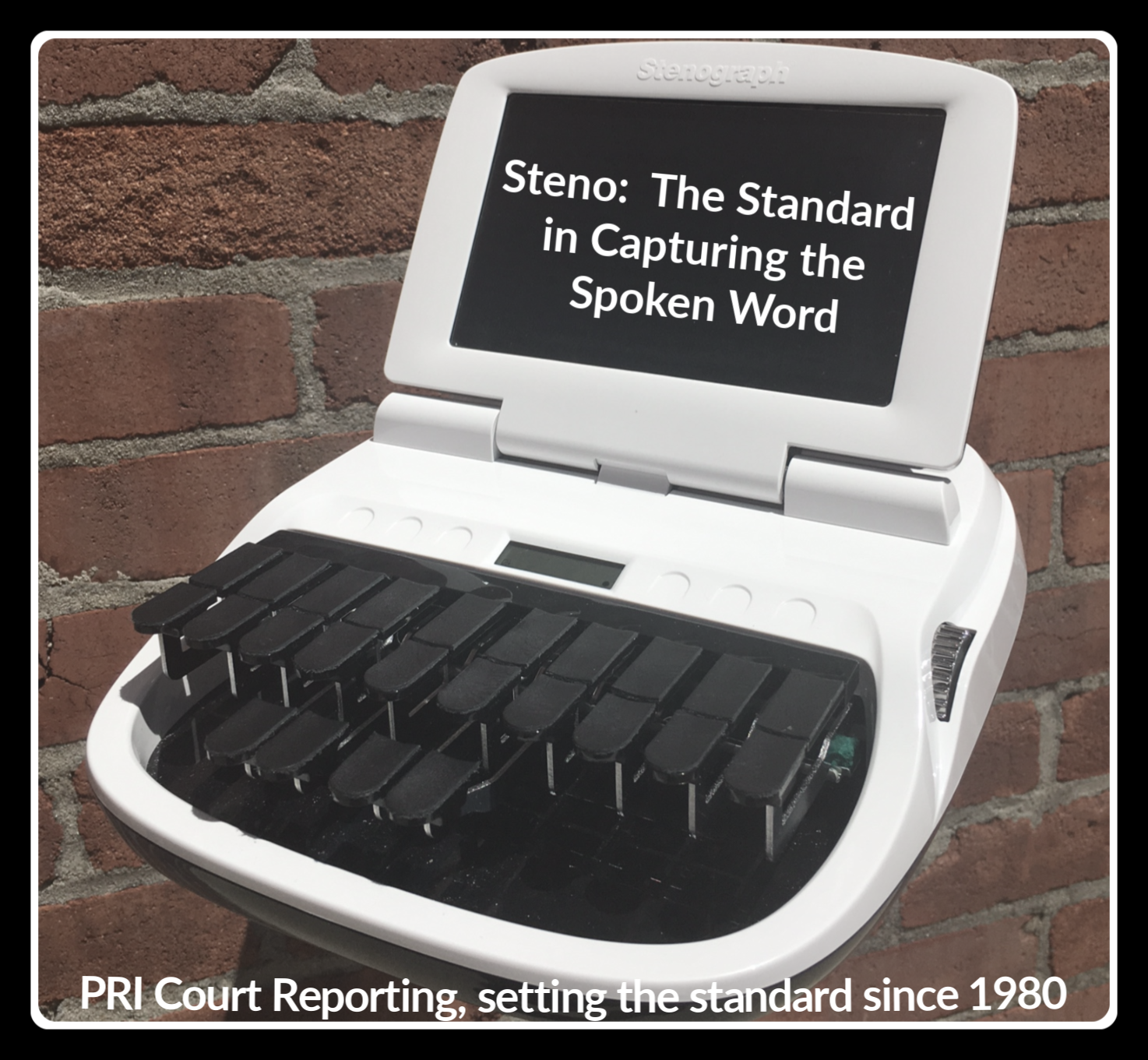
A stenographic court reporter captures testimony live, in real time, using a stenographic machine or voice-writing equipment. A digital court recorder typically records the proceedings and after the proceedings, a transcriptionist produces a transcript from the recording. Every PRI transcript is produced and certified by a trained stenographic court reporter — ensuring it’s admissible, accurate, and complete.


3. Is There a Shortage of Court Reporters?

Not necessarily a shortage, but as veteran reporters retire, the demand for skilled reporters continues to rise nationwide. It’s one reason PRI invests in supporting and retaining experienced professionals. Our clients benefit from PRI’s longstanding relationships and reputation for stability.


4. How Long Does It Take to Get a Transcript?

Turnaround times depend on your needs. PRI offers standard delivery for most transcripts, which is 10 business days, along with expedited and daily copy services when time is critical. Every transcript is reviewed for accuracy and formatted to our transcript specifications — ensuring quality never takes a back seat to speed.


5. What Is Realtime Reporting?

Realtime reporting allows attorneys to view the transcript as it’s being written — word for word — during the proceeding. It’s invaluable for strategy, review, and note-taking. PRI’s Certified Realtime Reporters provide this service seamlessly, both in person and remotely.


6. Do You Offer Remote or Hybrid Depositions?

Yes. PRI was among the first in Central Ohio to adopt secure, reliable remote deposition technology. Whether your case involves local witnesses or participants across the country, our team handles every detail — from virtual exhibits to realtime streaming — with the same professionalism you expect in person.


7. Can I Get a Rough Draft Transcript the Same Day?

Absolutely. When strategy can’t wait, PRI offers rough drafts delivered within hours of your proceeding. Our reporters use advanced realtime software to assist in producing accurate drafts quickly, allowing you to review testimony and prepare for the next day’s session with confidence.


8. Do You Provide Videography or Legal Video Services?

Certainly.  PRI can schedule legal videographers who work seamlessly alongside our court reporters to create a synchronized record of both testimony and demeanor. We also provide video-text synchronization for trial presentation, formatted to your specifications.


9. Are Your Court Reporters Certified?

Yes, PRI’s reporters are highly trained and experienced professionals holding state and national certifications such as Registered Professional Reporter (RPR), Registered Merit Reporter (RMR), and Certified Realtime Reporter (CRR). We also have reporters certified in California, Illinois, and Michigan.  Certification ensures our reporters meet the highest standards for speed, accuracy, and ethics.


10. How Does PRI Handle Depositions That Run Long or Get Rescheduled?

We understand that legal proceedings can change quickly. Our scheduling team remains flexible and responsive, adjusting to extensions, cancellations, or new start times with professionalism and courtesy.


11. How Can I Schedule a Deposition with PRI?

We make scheduling simple. You can schedule online at priohio.com, call our scheduling team, or email directly. Whether your proceeding is in person, remote, or hybrid, PRI coordinates every detail so you can focus on your case — not logistics.


12. Why Choose PRI Court Reporting?

Because experience matters. For over 45 years, PRI has partnered with attorneys, firms, and courts who value reliability and excellence. From realtime reporting to secure file management, we provide complete, client-focused solutions tailored to your needs.  Every transcript, every proceeding, every client receives the full measure of our attention and expertise. We’re not just capturing words — we’re preserving accuracy, trust, and the integrity of the record.


Closing Thoughts

Court reporting is more than a profession — it’s a commitment to the preservation of the legal record. At PRI, we’ve built our reputation on that commitment for over four decades. Whether you’re an attorney, paralegal, or client, you can count on us to deliver clarity, confidentiality, and excellence on every page.

PRI Court Reporting — Experience. Precision. Integrity.
Visit us at priohio.com to schedule your next proceeding or learn more about our services.

Protect Your Client. Protect Your Record.

Protect Your Client. Protect Your Record.

Can we have a word?

You may be receiving marketing materiSteno machine standardals and sales pitches from national court reporting firms about alternative ways to preserve testimony at your depositions, namely “digital reporting.”  They are suggesting you change the language of your deposition notices to “broadly reflect variable methods  of capture.”  Perhaps you haven’t heard a thing about this yet.  Either way, it’s important that you are fully aware of some of the complications of this emerging practice.

These national firms are suggesting that digital reporting at a deposition is comparable to having a stenographic reporter present at the deposition.  They are suggesting that a shortage of stenographic court reporters has created a need for this alternative method of preserving testimony.  They are suggesting that this will assure you coverage for your depositions.  We disagree with this stance and we feel very strongly that the stenographic profession is strong, very capable, and committed to the service we provide to the legal community.

While we are not seeing these challenges in the Ohio area yet, there are cities across the country where attorneys that are required by their client to use these large firms (an issue for another day!) are facing the challenge of getting their depositions covered with stenographic reporters, thereby having to reschedule or cancel them.   There are several reasons some of these national firms have trouble finding court reporters to cover these jobs, including low rates to the court reporter due to contracting with insurance companies and corporations.

As a local, court reporter-owned firm with over 30 years of experience, we want to make sure you have enough information to understand the complexities of this situation if you’re ever faced with it, either in Ohio or when traveling to other cities for depositions.

In the states that have court reporting certification and professional standards, such as California and Texas, having a digital “reporter” present at a deposition could jeopardize your record, your case, and your relationship with your client.  In California, stenographic reporters are licensed by a board in the same state department that regulates CPAs, physicians, and other professionals1.  They are subject to discipline by that board for their conduct.   Machine operators or digital recorders are not trained, certified, or regulated in any way by the state.

According to the Deposition Reporters Association of California, when you agree to utilize a digital reporter for your deposition in California, you run the risk of the following:

Here are just a few advantages of having a stenographic reporter over a digital reporter, regardless of where your deposition is held:

The bottom line here is that there are still many qualified, certified stenographic court reporters available for depositions across the country.  Don’t let the national firms scare you into changing your deposition notice language to include “digital audio equipment or any other alternative means of capture.”

Choose a licensed or certified stenographic court reporter for your record every time.  If you’re traveling to other cities or states for your deposition, be sure to request a “stenographic court reporter” when scheduling with your chosen court reporting firm.  If you ask for a certified stenographic court reporter (whether certified by the state or NCRA), you can be assured you’ll receive a quality transcript, which is exactly what you and your client deserve.

ABOUT THE AUTHOR:

Angie Starbuck, RDR/CRR/CRC is a court reporter in Columbus, Ohio, and the owner of PRI Court Reporting, LLC. Connect with her on LinkedIn.  You can also follow PRI Court Reporting on Twitter and Facebook.


1Deposition Reporters Association of California, Inc., www.caldra.org

2There are many, many examples of malfunctions. Here is an excerpt from a 2012 case in New York involving a prisoner: “[t]he petitioner’s transcriber documented numerous and lengthy gaps in the hearing tape, which rendered much of the transcript unintelligible. Based upon the foregoing, the Court found that the condition of the transcript was such that it, indeed, precluded meaningful review of the disciplinary determination.”

3CCP section 2025.340(m): “ … If no stenographic record of the deposition testimony has previously been made, the party offering an audio or video recording of that testimony under Section 2025.620 [impeachment] shall accompany that offer with a stenographic transcript prepared from that recording. (Emphasis added.) “Audio or video recordings made by the parties or by the deposition reporter … are not considered recordings of the proceedings. Only the stenographic transcript qualifies” ]Weil & Brown, Cal. Prac. Guide Civ. Pro. Before Trial Ch. 8E-14, The Rutter Group,(June 2018), Chapter 8. Discovery, Chapter 8E. Depositions, 14. [8:766], “If the testimony is recorded stenographically, it must be recorded by a certified shorthand reporter.” Serrano v. Stefan Merli Plastering Co. (2008) 162 Cal.App.4th 1014, 1033

Download the Deposition Scheduling Checklist

  • This field is for validation purposes and should be left unchanged.

A Celebration of Life and a Life of Service

A Celebration of Life and a Life of Service

Five years ago, I purchased PRI from my longtime boss and mentor, Linda Sturm.  Five years ago, I wrote a blog article to celebrate her birthday.  This November, I attended a Celebration of Life service to honor, remember, and celebrate the life of Linda, who was no ordinary woman.  Her friends, family, coworkers, and employees all gathered to celebrate her life and her journey in this world.  I feel honored and fortunate to have shared 20 years of my career with Linda.  I am a better person, court reporter, and firm owner because of her.

Below is the blog article I wrote in 2012 to celebrate and honor Linda’s birthday.  I don’t believe it’s a coincidence that this year, too, she is embarking on a new journey in heaven with her God.


A young man is graduating from Marine Corps boot camp this weekend. He is a Marine today and will be forever. His name is Zachary and he is only 19 years old. Zach is on the doorstep of the rest of his life and I’m sure he is proud, happy, and scared all at the same time. The Marine Corps also celebrates its birthday tomorrow. This is a unique holiday for these warriors, who celebrate and honor the Corps and country.

Linda Sturm, the founder of PRI, is also celebrating her birthday on November 10. It took me almost 20 years to put two and two together to realize that Linda and the Marine Corps share the same birthday. And how appropriate to recognize that fact in 2012. Linda founded this company over 30 years ago, and at the time, I’m sure she felt many of the same feelings Zach will be feeling this weekend. It was probably an overwhelming, scary, yet happy time for her! Linda is also embarking on a new stage of her life in 2013, one that is probably equally uncertain, yet happy, since she has retired from PRI.

As the sister of a Marine, a friend of Zach’s, and a loyal employee and friend of Linda’s, I’m pleased that they are all sharing this special day. I wish them all the very best of luck, the strength to face their challenges, and the protection of the Lord as they move forward.

Happy birthday, Linda, and the Marine Corps.  Congratulations, Zach, and Godspeed.

Introducing Sarah Tsekretsidis, PRI Court Reporting Office Administrator

Introducing Sarah Tsekretsidis, PRI Court Reporting Office Administrator

Webp.net-resizeimagePlease join us in welcoming Sarah Tsekretsidis to the PRI team.  Sarah is our office administrator and handles our invoicing, scheduling, payroll, accounting, and office administration.  Sarah has picked up very quickly on the court reporting industry and she is able to provide solutions to our clients’ challenges. She is very thorough and has excellent customer relations skills, working to resolve client requests promptly.

Here’s an opportunity to learn a little more about Sarah:

How long have you been working at PRI Court Reporting?
I have been with PRI since April 2017.

Describe what you do at PRI.
At PRI, I am the Office Administrator. I help with everything from scheduling depositions to invoicing to tech support. I am usually the first person you talk to when calling our office.

Did you have any court reporting experience prior to joining PRI?
I did not. This industry was completely new to me.

What is your favorite part about working at PRI?
I love that no two days are the same, and there’s always something new to learn. It’s awesome that I have co-workers that allow me to ask a ton of questions to understand the ins and outs of the court reporting field.

Where are you from or where did you grow up?
Born and raised right here in Columbus!

What was the first job you ever had?
I was a babysitter for my first job in middle school. I had a couple of families I would sit for. Then I became a hostess at Old Bag of Nails in high school.

What do you like to do when you’re not at work?
When I’m not at work, I’m out adventuring with my family. From swim lessons to Crew games to metro parks, we always find something to do. I have also really started to enjoy cooking. It’s been fun finding new and unusual veggies to try and incorporate into dishes. And I always try to take up gardening, but fail miserably at it.

What is one thing our clients don’t know about you?
Probably how to pronounce my last name.  🙂  It’s see-krit-si-dees.
Or like the two words: secret – cds

What is one thing you would like our clients to know about scheduling jobs with PRI?
With scheduling, the more details the better. This is especially helpful with depositions where one or more parties will be attending remotely. If I can know all the details about who is expected to be where, then I can effectively communicate the phone or videoconference details – ensuring no party gets left out.

What is your favorite restaurant in Columbus?
Nada, in the Arena District. Their tacos are amazing, and I can’t get enough of the chili-glazed potatoes.

What is your favorite app?
Giphy. So many gifs to choose from, it never disappoints.

What’s on your iPod?
iPod?! Do they still make those 😉  I have recently gotten into podcasts. I like listening to shows that revolve around health and wellness, mindfulness, and of course a good ol’ mystery.


We hope you’ve enjoyed learning a little more about Sarah.  Look for more interviews with other PRI Court Reporting staff in the future.

Download the Deposition Scheduling Checklist

  • This field is for validation purposes and should be left unchanged.

Jury Duty and CART

Jury Duty and CART

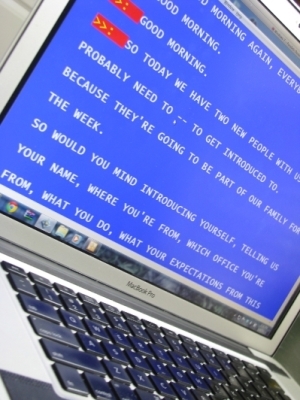
Sample of CART display

Recently PRI was contacted to provide CART (Communication Access Realtime Translation) services to a potential juror in Franklin County, Ohio, who was hard of hearing.  This individual (consumer) has used CART services in the past and was very familiar with the benefits and impact of CART.

CART is accomplished by having a court reporter listening and taking down what is being said and transmitting the feed to a laptop for the consumer to view and read.  It is the position of the National Court Reporters Association that, “A CART provider should refrain from working in the dual capacity of official reporter of proceedings and CART,” unless no other option exists.  That’s where PRI became involved.

After some discussion on the logistics with the court staff, I attended the first jury pool meeting with the consumer and sat with her until she was called for voir dire (questioning of potential jury members) in a courtroom.  I then proceeded to sit with her and provide CART for her until the trial began.  The consumer was selected as a juror and another CART provider worked with her throughout the rest of the trial (see the blog post from her here).

There were three exciting things about this assignment for me:

I always enjoy the opportunity to share our profession with the public and, at the same time, provide much-needed services so that a consumer can participate in an event or meeting just like everyone else.  If you ever have the opportunity to talk with a court reporter or CART provider, feel free to ask them about their profession (preferably on a break, when they’re not writing!) and I’m sure they would be glad to share their experiences with you.


ABOUT THE AUTHOR:

Angie Starbuck, RDR, CRR, CRC is a court reporter in Columbus, Ohio, and the owner of PRI Court Reporting, LLC.  PRI has been a leader in the CART and captioning services industry for over 25 years and provides CART and captioning regularly for individuals in the legal, corporate, and educational settings.  Connect with Angie on LinkedIn.  You can also follow PRI Court Reporting on Twitter and Facebook.

Download the Deposition Scheduling Checklist

  • This field is for validation purposes and should be left unchanged.


My Experience with Jury Duty – by Rhonda Lawrence

My Experience with Jury Duty – by Rhonda Lawrence

16140571199_fddf693906_z (1)I have been called to jury duty twice, and both times I was released immediately for the mere fact that I am a court reporter, being told I know too much about the legal process and know too many attorneys.  So you can imagine my excitement when I was asked to be a CART (Communication Access Realtime Translation) provider for a hearing-impaired juror.  Not only was it my first opportunity to sit with a jury, but it was also my first murder trial.  Working as a freelance reporter, generally all of my work is civil in nature.

The trial went about as any typical trial does.  Having been an official reporter, I know the things that go on outside of the jury’s presence.  This time, since I was sitting with the juror and none of that was presented to “us,” I found myself envious of the official reporter.  I wanted to hear the bench conferences; I wanted to know why someone in the gallery was asked to leave; I wanted to know why certain witnesses and evidence was not presented; I wanted to know what both sides said about the jury instructions; I wanted to know the “history” of the case.  All things I otherwise would have known as the official reporter.

The case was closed and the time came for deliberations, which is what I was most excited about.  Having not been the CART provider for this particular voir dire selection, I did not know the background of any of the jurors.  I found myself intrigued by all of the different perspectives everyone had, wondering what their background is for them to hold the opinions they did, questioning in my mind why they thought certain things were or weren’t important to the case, and speculating on evidence that was not presented.  It was interesting that everyone heard such different testimony from the same witness.  It was very difficult for me, when they would argue over what was or wasn’t said, to not be able to just pull it up on the screen and show them, as I would do in a deposition setting.

As a freelance reporter, I usually only get to hear one side of the story and I never know the outcome of a case.  So you can imagine my frustration when the outcome ended up being a hung jury!

ABOUT THE AUTHOR:

Rhonda Lawrence is a court reporter with PRI Court Reporting, LLC, in Columbus, Ohio.  You can learn more about Rhonda here.  You can also follow PRI Court Reporting on Twitter and Facebook.

Download the Deposition Scheduling Checklist

  • This field is for validation purposes and should be left unchanged.

Are YOU Your Toughest Competitor?

Are YOU Your Toughest Competitor?

“The individual who only does enough to get by seldom gets much more than “by.” – Napoleon Hill

We’ve all heard the sayings, “You get out what you put in,” or “Garbage in, garbage out,” but this quote that I received in my daily e-mail from the Napoleon Hill Foundation freshened up this principle for me.

If you want to get more than “by,” how about applying these principles to your career, your faith, and your personal relationships in the coming year?  Not a New Year’s resolution, but a commitment to yourself to do your personal best every day.

The phrase that struck me the most in this particular daily e-mail was, “Your harshest critic and your toughest competitor should be you.”  We’re all probably really good at being our own harshest critic, but are we all our toughest competitor?

Do you strive to be/do/think/act better than you did the day before?  Do you seek higher achievements than you did last year?  Do you take the initiative at work to improve a process, make a job easier, save the company money?

Sometimes it’s easy to look at our competitors and try to compete with them when it’s really ourselves that we should be competing with.  If we do that, the achievements we seek will happen because we’re working hard to better ourselves.


ABOUT THE AUTHOR:

Angie Starbuck, RDR, CRR, CRC is a court reporter in Columbus, Ohio, and the owner of PRI Court Reporting, LLC. Connect with her on LinkedIn.  You can also follow PRI Court Reporting on Twitter and Facebook.

Download the Deposition Scheduling Checklist

  • This field is for validation purposes and should be left unchanged.

Inside Look at PRI Court Reporting

Inside Look at PRI Court Reporting

_dsc3326editedThe PRI court reporters are definitely the face of our company.  They are the people who are out in the field daily, working with attorneys, expert witnesses, consumers of CART, etc.  They represent the best of our brand here at PRI and each one of them embodies the traits we list in our tagline:  Prompt.  Precise.  Professional.

But we would be remiss if we didn’t mention our fantastic office staff. Gary and Gina are the behind-the-scenes staff that work hard to meet all of our clients’ needs.  They handle scheduling, transcript production, exhibit scanning, invoicing…the list goes on!

Here’s a fun video clip to give you a little sneak peek into the office and work spaces inside PRI.

You’re welcome to stop by for a visit to say hello!

Click here to view the video.


An Interview with Columbus Court Reporter – Amy L. Miller

An Interview with Columbus Court Reporter – Amy L. Miller

Amy Miller recently joined the team at PRI Court Reporting.  Amy is a court reporter in Columbus, Ohio and she has been a court reporter for over 20 years. Amy is very friendly and cares a lot about her work and her family.  You’ll meet Amy at a deposition soon, but in the meantime, here’s a chance to get to know her a little better.

How long have you been a court reporter?
I started reporting 21 years ago this month!

How long have you been working at PRI Court Reporting?
I am thrilled to have started PRI Court Reporting in November of 2015

Did you have other court reporting experience prior to joining PRI?
I did.  I was with two other local firms before joining PRI

What do you like most about working at PRI?
So far, I am really enjoying the office staff, clientele, and software.  I love the atmosphere!

Where are you from or where did you grow up?
I was born at St. Ann’s Hospital.  While much of my family has decided to leave central Ohio, this is my home.

Before working as a court reporter, did you have another career or job? If so, what?
I heard a commercial for the “glamorous life of court reporting” on the radio when I was a senior in high school.  I decided right then and there that this was the path I was taking and I never looked back.

What is one thing you would like our clients to know about court reporting/depositions? 
Court reporters put their hearts into your transcripts.  It is really helpful to state your goals for them (i.e., expedited due dates, unusual spellings that are case-specific) as these things arise so we can keep up with your needs!

What is the most unusual deposition situation you’ve found yourself in?
Once I was in a situation where emotions ran so high, the police were called and me and my machine were knocked over all while still on the record!  Who says court reporting isn’t interesting?

What’s on your iPod?
Oh, I love music!  My iTunes library has over 3,000 songs in so many genres, I couldn’t even begin to list what’s on it!

What is one thing our clients don’t know about you?
I am a hard-core couponer.  Like following websites for the best “deals” of the week and looking forward to the Sunday paper.  I find this fun.  I started doing it way before they made a silly TV show about people that coupon.

What is your favorite restaurant in Columbus?
That’s a tough question. For a special evening, The Refectory.  For a nice evening, Polaris Grill.  To carry home, Golden Valley.

What is your favorite app?
Without a doubt, my favorite app is Spotify.  There is so much music to choose from, and the ability to download and listen and make your own playlists is just awesome.

What do you like to do when you’re not at work?
I love to cook and do prepare meals most days of the week; spend time with my son; hang out with my friends and family.  I have two dogs and a cat and I am crazy about them as well. My favorite times involve all of these cool people and furry animals all landing in the same place!

What is your best tip for balancing work/life/family?
Sometimes our jobs can be a real balancing act when it comes to work life/family life and it doesn’t always work out.  Expedited transcripts happen and we don’t always know they are going to.  The people that love us are aware that is a possibility and are good about working around that.  However, for the most part, the way I have found that works best is to have a dedicated room in my home for an office that has a door that can be shut during off hours.  So when I am done for the day, the door gets shut and then work is over and my home becomes my home again.  Balance.


We hope you’ve enjoyed learning a little more about Amy.  Look for more interviews with other PRI Court Reporting staff in the future.

Download the Deposition Scheduling Checklist

  • This field is for validation purposes and should be left unchanged.


PRI Owner, Angie Starbuck, Earns Registered Diplomate Reporter Designation

PRI Owner, Angie Starbuck, Earns Registered Diplomate Reporter Designation

The National CoStarbuck, Angie 8.15 sml IMG_0087urt Reporters Association (NCRA), the country’s leading organization representing stenographic court reporters and captioners, has announced that Angie Starbuck has earned the nationally recognized Registered Diplomate Reporter (RDR) certification, the highest credential available to stenographic court reporters. The reporters with the RDR credential are recognized as highly experienced and seasoned, and are members of the profession’s elite.

“Earning RDR credentials is a reflection of the commitment to advancement in a court reporter’s career and their professional growth. RDRs truly are the elite members of the court reporters and captioners when it comes to experience and knowledge of the latest technology, reporting practices, and professional practices,” says Mike Nelson, CAE, NCRA’s Executive Director and CEO. “This highly prestigious certification.”

“I was inspired to reach for these certification goals by the previous owner of my firm, and I’m very proud of these accomplishments.  This has involved countless hours of practicing, learning, and continuing education.  These certifications and the knowledge and skill gained by achieving them will help me be a better court reporter and better firm owner,” Starbuck said.


Top