The 12 Most Common Questions from Attorneys and Paralegals About Court Reporting — Answered by PRI Court Reporting

The 12 Most Common Questions from Attorneys and Paralegals About Court Reporting — Answered by PRI Court Reporting

For more than 45 years, PRI Court Reporting has been trusted by law firms, corporations, and courts across Ohio and the Midwest for precise, professional, and reliable record-taking. Over the years, we’ve heard many of the same questions from attorneys, paralegals, and clients — about our process, our technology, and what makes this profession so vital to the justice system.

We’ve gathered the answers to the most frequently asked questions about court reporting — drawn from our experience and expertise. Whether you’re a longtime client or simply curious about what we do, this guide offers a behind-the-scenes look at the work we do that ensures every word counts.


1. Is Court Reporting Being Replaced by Artificial Intelligence?

While technology supports our work, it cannot replace it. AI lacks the context, accuracy, and impartiality that certified court reporters provide. At PRI, we use technology to enhance our service — never to replace the human expertise that defines it.


2. What’s the Difference Between a Stenographic Court Reporter and a Digital Court Recorder?

A stenographic court reporter captures testimony live, in real time, using a stenographic machine or voice-writing equipment. A digital court recorder typically records the proceedings and after the proceedings, a transcriptionist produces a transcript from the recording. Every PRI transcript is produced and certified by a trained stenographic court reporter — ensuring it’s admissible, accurate, and complete.


3. Is There a Shortage of Court Reporters?

Not necessarily a shortage, but as veteran reporters retire, the demand for skilled reporters continues to rise nationwide. It’s one reason PRI invests in supporting and retaining experienced professionals. Our clients benefit from PRI’s longstanding relationships and reputation for stability.


4. How Long Does It Take to Get a Transcript?

Turnaround times depend on your needs. PRI offers standard delivery for most transcripts, which is 10 business days, along with expedited and daily copy services when time is critical. Every transcript is reviewed for accuracy and formatted to our transcript specifications — ensuring quality never takes a back seat to speed.


5. What Is Realtime Reporting?

Realtime reporting allows attorneys to view the transcript as it’s being written — word for word — during the proceeding. It’s invaluable for strategy, review, and note-taking. PRI’s Certified Realtime Reporters provide this service seamlessly, both in person and remotely.


6. Do You Offer Remote or Hybrid Depositions?

Yes. PRI was among the first in Central Ohio to adopt secure, reliable remote deposition technology. Whether your case involves local witnesses or participants across the country, our team handles every detail — from virtual exhibits to realtime streaming — with the same professionalism you expect in person.


7. Can I Get a Rough Draft Transcript the Same Day?

Absolutely. When strategy can’t wait, PRI offers rough drafts delivered within hours of your proceeding. Our reporters use advanced realtime software to assist in producing accurate drafts quickly, allowing you to review testimony and prepare for the next day’s session with confidence.


8. Do You Provide Videography or Legal Video Services?

Certainly.  PRI can schedule legal videographers who work seamlessly alongside our court reporters to create a synchronized record of both testimony and demeanor. We also provide video-text synchronization for trial presentation, formatted to your specifications.


9. Are Your Court Reporters Certified?

Yes, PRI’s reporters are highly trained and experienced professionals holding state and national certifications such as Registered Professional Reporter (RPR), Registered Merit Reporter (RMR), and Certified Realtime Reporter (CRR). We also have reporters certified in California, Illinois, and Michigan.  Certification ensures our reporters meet the highest standards for speed, accuracy, and ethics.


10. How Does PRI Handle Depositions That Run Long or Get Rescheduled?

We understand that legal proceedings can change quickly. Our scheduling team remains flexible and responsive, adjusting to extensions, cancellations, or new start times with professionalism and courtesy.


11. How Can I Schedule a Deposition with PRI?

We make scheduling simple. You can schedule online at priohio.com, call our scheduling team, or email directly. Whether your proceeding is in person, remote, or hybrid, PRI coordinates every detail so you can focus on your case — not logistics.


12. Why Choose PRI Court Reporting?

Because experience matters. For over 45 years, PRI has partnered with attorneys, firms, and courts who value reliability and excellence. From realtime reporting to secure file management, we provide complete, client-focused solutions tailored to your needs.  Every transcript, every proceeding, every client receives the full measure of our attention and expertise. We’re not just capturing words — we’re preserving accuracy, trust, and the integrity of the record.


Closing Thoughts

Court reporting is more than a profession — it’s a commitment to the preservation of the legal record. At PRI, we’ve built our reputation on that commitment for over four decades. Whether you’re an attorney, paralegal, or client, you can count on us to deliver clarity, confidentiality, and excellence on every page.

PRI Court Reporting — Experience. Precision. Integrity.
Visit us at priohio.com to schedule your next proceeding or learn more about our services.

Is Your GPS Set to the Right Destination?

Is Your GPS Set to the Right Destination?

Every year the National Court Reporters Association holds a Business Summit for court reporters and firm owners to network with other firm owners and gain business tools to help with their success.  Photo by capnsnap on Unsplash

While attending the Business Summit this year, we attended a session that was presented by a very engaging speaker by the name of Karim Ellis.  He was full of personality and was able to present his ideas and message in a very relatable way.

One of his sessions was called “GPS Your Success.”  Here’s the theory:  When you enter your destination into a GPS, that GPS will focus solely on getting you to that destination.  You may take detours, you may have distractions, but that GPS stays focused on the destination you entered.

How does this relate to your life and career?  Setting a goal and achieving it is similar to using a GPS to arrive at your destination.  Here’s how Karim described the similarities:

  1.  Set a goal/vision.  You have to set your vision or goal that you want to achieve.  It could be long-term or short-term.  This is like setting the address in your GPS.
  2. Clarity helps the journey. Be very clear and specific about how you will achieve that goal.  Remember, the opposite of clarity is confusion.  If you don’t have specific steps to reach your goal, you’ll easily get off track or confused about your goal.  Imagine if your GPS gave you unclear directions – would you be able to reach your destination as easily or quickly?
  3. Connectability vs. dead zones. Who are you connecting with to help you achieve your goal?  Do you have an accountability partner?  Are the people you are connecting with helping you to achieve your desired goal?  What are your dead zones?  Dead zones could be friends, family, or even your job.  What stops your GPS from working towards your goal?
  4. Dealing with distractions. While distractions will come along during your journey, if you have a stated goal, clarity on how to achieve it (even if there are distractions) you can get back on track towards your goal.  Just like a GPS stays focused only on the address you enter; it will keep recalculating and getting you back on track to your destination.
  5. Are you loyal? Check the history log on your journey – have you entered lots of “addresses” that don’t get you to your ultimate goal?  Are you staying loyal to your path towards that goal?

This analogy seems to be relatable to a personal goal, professional goal, and even students working to get through school.  Think of your journey towards a goal as being similar to traveling with a GPS.  Applying these principles will help you stay on track and achieve that goal you have set for yourself!

Happy travels!! 


ABOUT THE AUTHOR:

Angie Starbuck, RDR/CRR/CRC is a court reporter in Columbus, Ohio, and the owner of PRI Court Reporting, LLC. Connect with her on LinkedIn.  You can also follow PRI Court Reporting on Twitter and Facebook.

You can find more information about Karim R. Ellis here or on Twitter and Facebook.

Would You Jeopardize Your Case?

Would You Jeopardize Your Case?


justice-683942_640

Many attorneys and paralegals across the country get calls, e-mails, solicitations from large court reporting firms with an offer of great perks if the attorney will agree to allow that firm to cover all of their depositions.  Perhaps you personally have been the recipient of these efforts.  Your client, whether a large corporation or insurance company, may also be the recipient of these efforts.  These offers always sound beneficial in one way or another.  It may be a reduced rate on the transcript order.  It may be a waived appearance fee.  It may be gift cards to restaurants, iPads, bottles of wine.  All of these can be enticing and may be persuasive in your decision to switch court reporting firms.

However, there are several reasons this practice is not in your best interest or that of your client, the most important of which is the risks this could mean to your case.  Many states have adopted rules prohibiting certain contractual arrangements for court reporting services, including Ohio.

The Ohio Rules of Civil Procedure, specifically Rule 28(D), state that, “(1) Any blanket contract for private court reporting services, not related to a particular case or reporting incident, shall be prohibited between a private court reporter or any other person with whom a private court reporter has a principal and agency relationship, and any attorney, party to an action, party having a financial interest in an action, or any entity providing the services of a shorthand reporter. (2) “Blanket contract” means a contract under which a court reporter, court recorder, or court reporting firm agrees to perform all court reporting or court recording services for a client for two or more cases at a rate of compensation fixed in the contract.”

The Ohio Rules of Civil Procedure also state, “This prohibition is enforceable by the court in which the underlying action is pending. Enforceability is implicitly recognized by Civ. R. 32(D)(2), which requires reasonable diligence of a party in raising a disqualification issue.”  Rule 32(D)(2) states, “Objection to taking a deposition because of disqualification of the officer before whom it is to be taken is waived unless made before the taking of the deposition begins or as soon thereafter as the disqualification becomes known or could be discovered with reasonable diligence.”  This leaves the burden of discovering any reasons for disqualification on the attorneys in the case, one of which could be the violation of Rule 28(D) by the court reporter or court reporting firm.

So the question is: Would you want to risk your case, or your client’s goodwill and reputation, for a few cents per page, a bottle of wine, or restaurant gift cards?

As officers of the court, court reporters have a responsibility to be fair and impartial toward each participant in all aspects of reported proceedings and be alert to situations that are conflicts of interest or that may give the appearance of a conflict of interest.  We should also guard against not only the fact but the appearance of impropriety. (NCRA, 2017)

Sarah Nageotte, Executive Director of the Ohio Court Reporters Association and a Past President of the National Court Reporters Association, indicates that “Court reporters have long been held as the guardians of the record.  Litigants, the Bar, and the public must have confidence and trust in the process, and it is vital that the court reporting community fulfills its role impartially and above reproach.”

The National Court Reporters Association’s Committee on Professional Ethics and Board of Directors have adopted the following language, stating that members, “Refrain from giving, directly or indirectly, any gift or anything of value to attorneys or their staff, other clients or their staff, or any other persons or entities associated with any litigation, which exceeds $150 in the aggregate per recipient each year.   Nothing offered in exchange for future work is permissible, regardless of its value. “

Protect yourself and your client. Hire a reporter based on skill and experience who puts ethics first.


ABOUT THE AUTHOR:

Angie Starbuck, RDR/CRR/CRC, is a court reporter in Columbus, Ohio, and the owner of PRI Court Reporting, LLC. She is an NCRA member and an NCRA Ethics First member.  Connect with her on LinkedIn and Google+.

Are YOU Your Toughest Competitor?

Are YOU Your Toughest Competitor?

“The individual who only does enough to get by seldom gets much more than “by.” – Napoleon Hill

We’ve all heard the sayings, “You get out what you put in,” or “Garbage in, garbage out,” but this quote that I received in my daily e-mail from the Napoleon Hill Foundation freshened up this principle for me.

If you want to get more than “by,” how about applying these principles to your career, your faith, and your personal relationships in the coming year?  Not a New Year’s resolution, but a commitment to yourself to do your personal best every day.

The phrase that struck me the most in this particular daily e-mail was, “Your harshest critic and your toughest competitor should be you.”  We’re all probably really good at being our own harshest critic, but are we all our toughest competitor?

Do you strive to be/do/think/act better than you did the day before?  Do you seek higher achievements than you did last year?  Do you take the initiative at work to improve a process, make a job easier, save the company money?

Sometimes it’s easy to look at our competitors and try to compete with them when it’s really ourselves that we should be competing with.  If we do that, the achievements we seek will happen because we’re working hard to better ourselves.


ABOUT THE AUTHOR:

Angie Starbuck, RDR, CRR, CRC is a court reporter in Columbus, Ohio, and the owner of PRI Court Reporting, LLC. Connect with her on LinkedIn.  You can also follow PRI Court Reporting on Twitter and Facebook.

Download the Deposition Scheduling Checklist

  • This field is for validation purposes and should be left unchanged.

Captioning

Captioning

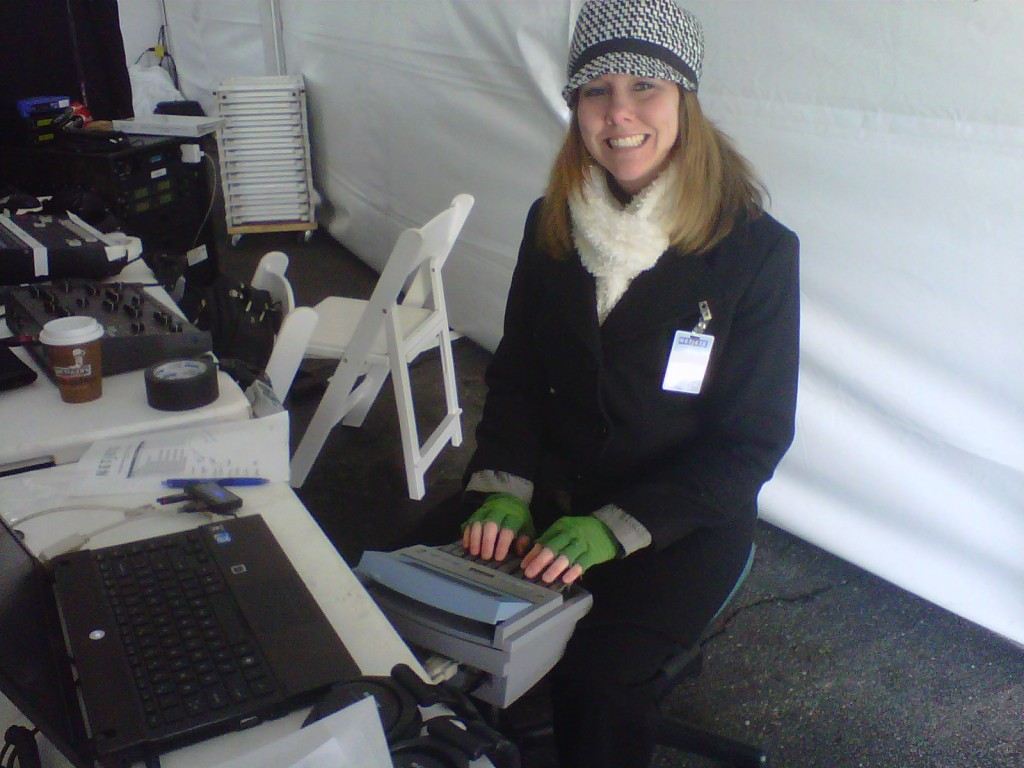
Captioning is glamorous; right? But 40 degrees! In a tent. Really!

Streaming Text

Streaming Text

PRI can stream your text over the Web. The participants merely log on to www.priohio.com and go to the chat room and can securely watch what is being said.

Witnesses, other attorneys in the case, or participants at seminars might find this useful. The reporter only needs an Internet connection. Call to schedule your realtime streaming text function.

Training and Learning in Warm Climates

Training and Learning in Warm Climates

PRI has had a busy February already with much training and learning.  Hard to believe it’s only Valentine’s Day.  Karen and Linda went to Tucson, Arizona, for the firm owners conference, and Angie Starbuck, Carmen Maley and Sara Clark went to Orlando, Florida for software training on Advantage software’s new Eclipse 5.  They just happened to be in warm climates.  Not that there’s anything wrong with Columbus, Ohio, in February.  Much was learned, and we all received a good dose of Vitamin D.

Wireless Realtime

Wireless Realtime

PRI reporters are utilizing wireless realtime – no more wires!  No more serial ports!  For more information, click on the Realtime Reporting tab.

PRI Offices

PRI Offices

PRI is located at 390 South Washington Avenue, Columbus, Ohio 43215. PRI is located to easy freeway access, has free parking, and is downtown Columbus, close to the courthouse. PRI has free deluxe conference rooms for depositions or video conference.

Top