The 12 Most Common Questions from Attorneys and Paralegals About Court Reporting — Answered by PRI Court Reporting

The 12 Most Common Questions from Attorneys and Paralegals About Court Reporting — Answered by PRI Court Reporting

For more than 45 years, PRI Court Reporting has been trusted by law firms, corporations, and courts across Ohio and the Midwest for precise, professional, and reliable record-taking. Over the years, we’ve heard many of the same questions from attorneys, paralegals, and clients — about our process, our technology, and what makes this profession so vital to the justice system.

We’ve gathered the answers to the most frequently asked questions about court reporting — drawn from our experience and expertise. Whether you’re a longtime client or simply curious about what we do, this guide offers a behind-the-scenes look at the work we do that ensures every word counts.


1. Is Court Reporting Being Replaced by Artificial Intelligence?

While technology supports our work, it cannot replace it. AI lacks the context, accuracy, and impartiality that certified court reporters provide. At PRI, we use technology to enhance our service — never to replace the human expertise that defines it.


2. What’s the Difference Between a Stenographic Court Reporter and a Digital Court Recorder?

A stenographic court reporter captures testimony live, in real time, using a stenographic machine or voice-writing equipment. A digital court recorder typically records the proceedings and after the proceedings, a transcriptionist produces a transcript from the recording. Every PRI transcript is produced and certified by a trained stenographic court reporter — ensuring it’s admissible, accurate, and complete.


3. Is There a Shortage of Court Reporters?

Not necessarily a shortage, but as veteran reporters retire, the demand for skilled reporters continues to rise nationwide. It’s one reason PRI invests in supporting and retaining experienced professionals. Our clients benefit from PRI’s longstanding relationships and reputation for stability.


4. How Long Does It Take to Get a Transcript?

Turnaround times depend on your needs. PRI offers standard delivery for most transcripts, which is 10 business days, along with expedited and daily copy services when time is critical. Every transcript is reviewed for accuracy and formatted to our transcript specifications — ensuring quality never takes a back seat to speed.


5. What Is Realtime Reporting?

Realtime reporting allows attorneys to view the transcript as it’s being written — word for word — during the proceeding. It’s invaluable for strategy, review, and note-taking. PRI’s Certified Realtime Reporters provide this service seamlessly, both in person and remotely.


6. Do You Offer Remote or Hybrid Depositions?

Yes. PRI was among the first in Central Ohio to adopt secure, reliable remote deposition technology. Whether your case involves local witnesses or participants across the country, our team handles every detail — from virtual exhibits to realtime streaming — with the same professionalism you expect in person.


7. Can I Get a Rough Draft Transcript the Same Day?

Absolutely. When strategy can’t wait, PRI offers rough drafts delivered within hours of your proceeding. Our reporters use advanced realtime software to assist in producing accurate drafts quickly, allowing you to review testimony and prepare for the next day’s session with confidence.


8. Do You Provide Videography or Legal Video Services?

Certainly.  PRI can schedule legal videographers who work seamlessly alongside our court reporters to create a synchronized record of both testimony and demeanor. We also provide video-text synchronization for trial presentation, formatted to your specifications.


9. Are Your Court Reporters Certified?

Yes, PRI’s reporters are highly trained and experienced professionals holding state and national certifications such as Registered Professional Reporter (RPR), Registered Merit Reporter (RMR), and Certified Realtime Reporter (CRR). We also have reporters certified in California, Illinois, and Michigan.  Certification ensures our reporters meet the highest standards for speed, accuracy, and ethics.


10. How Does PRI Handle Depositions That Run Long or Get Rescheduled?

We understand that legal proceedings can change quickly. Our scheduling team remains flexible and responsive, adjusting to extensions, cancellations, or new start times with professionalism and courtesy.


11. How Can I Schedule a Deposition with PRI?

We make scheduling simple. You can schedule online at priohio.com, call our scheduling team, or email directly. Whether your proceeding is in person, remote, or hybrid, PRI coordinates every detail so you can focus on your case — not logistics.


12. Why Choose PRI Court Reporting?

Because experience matters. For over 45 years, PRI has partnered with attorneys, firms, and courts who value reliability and excellence. From realtime reporting to secure file management, we provide complete, client-focused solutions tailored to your needs.  Every transcript, every proceeding, every client receives the full measure of our attention and expertise. We’re not just capturing words — we’re preserving accuracy, trust, and the integrity of the record.


Closing Thoughts

Court reporting is more than a profession — it’s a commitment to the preservation of the legal record. At PRI, we’ve built our reputation on that commitment for over four decades. Whether you’re an attorney, paralegal, or client, you can count on us to deliver clarity, confidentiality, and excellence on every page.

PRI Court Reporting — Experience. Precision. Integrity.
Visit us at priohio.com to schedule your next proceeding or learn more about our services.

Is Your GPS Set to the Right Destination?

Is Your GPS Set to the Right Destination?

Every year the National Court Reporters Association holds a Business Summit for court reporters and firm owners to network with other firm owners and gain business tools to help with their success.  Photo by capnsnap on Unsplash

While attending the Business Summit this year, we attended a session that was presented by a very engaging speaker by the name of Karim Ellis.  He was full of personality and was able to present his ideas and message in a very relatable way.

One of his sessions was called “GPS Your Success.”  Here’s the theory:  When you enter your destination into a GPS, that GPS will focus solely on getting you to that destination.  You may take detours, you may have distractions, but that GPS stays focused on the destination you entered.

How does this relate to your life and career?  Setting a goal and achieving it is similar to using a GPS to arrive at your destination.  Here’s how Karim described the similarities:

  1.  Set a goal/vision.  You have to set your vision or goal that you want to achieve.  It could be long-term or short-term.  This is like setting the address in your GPS.
  2. Clarity helps the journey. Be very clear and specific about how you will achieve that goal.  Remember, the opposite of clarity is confusion.  If you don’t have specific steps to reach your goal, you’ll easily get off track or confused about your goal.  Imagine if your GPS gave you unclear directions – would you be able to reach your destination as easily or quickly?
  3. Connectability vs. dead zones. Who are you connecting with to help you achieve your goal?  Do you have an accountability partner?  Are the people you are connecting with helping you to achieve your desired goal?  What are your dead zones?  Dead zones could be friends, family, or even your job.  What stops your GPS from working towards your goal?
  4. Dealing with distractions. While distractions will come along during your journey, if you have a stated goal, clarity on how to achieve it (even if there are distractions) you can get back on track towards your goal.  Just like a GPS stays focused only on the address you enter; it will keep recalculating and getting you back on track to your destination.
  5. Are you loyal? Check the history log on your journey – have you entered lots of “addresses” that don’t get you to your ultimate goal?  Are you staying loyal to your path towards that goal?

This analogy seems to be relatable to a personal goal, professional goal, and even students working to get through school.  Think of your journey towards a goal as being similar to traveling with a GPS.  Applying these principles will help you stay on track and achieve that goal you have set for yourself!

Happy travels!! 


ABOUT THE AUTHOR:

Angie Starbuck, RDR/CRR/CRC is a court reporter in Columbus, Ohio, and the owner of PRI Court Reporting, LLC. Connect with her on LinkedIn.  You can also follow PRI Court Reporting on Twitter and Facebook.

You can find more information about Karim R. Ellis here or on Twitter and Facebook.

In Memory of Linda Sturm

In Memory of Linda Sturm

lindasturm1955-2017

Our hearts are very heavy today after the passing of one of the co-founders of PRI, Linda Sturm. Linda co-founded Professional Reporters, Inc. (PRI) in 1980 and worked tirelessly to advance the court reporting field as well as the CART/captioning field. She was a leader in Columbus in both areas, which is demonstrated by being one of the first to provide realtime translation in depositions and developing and providing closed captioning for WCMH.

Linda had the opportunity to work alongside some of the best attorneys the city of Columbus has had. She often traveled with her clients to depositions and has been as far away as Germany, Slovenia, Norway, and Spain. She enjoyed attending depositions and meeting face-to-face with clients. Her Christmas parties from the early days of PRI are legendary!

Linda also had a great sense of humor, was thoughtful and giving, and led by example. Many court reporters attribute their success as a reporter to the mentorship of Linda.

She believed in sharing her expertise and experience with others, and did so by mentoring many young court reporters (and even some with more experience!), and by serving our associations at both the state and national level. Linda was a past president, vice president, and district director of the Ohio Court Reporters Association, and she worked diligently with the Ohio Supreme Court on the Task Force on the Certification of Court Reporters. She was very strong in her advocacy of our profession.

Most importantly, Linda touched the lives of many of us who were lucky enough to cross her path, both on a personal and professional level. Many court reporters in the Columbus area have either worked with Linda or worked for her at PRI, and she was a true leader and mentor. She encouraged us to push ourselves as reporters, instilled confidence in our abilities, and encouraged us to participate in our state and national associations.

Linda had such a positive attitude and she would encourage us to be grateful for everything we’ve experienced. However, we can’t help but mourn the loss the court reporting profession, the legal community, and the CART/captioning community is experiencing today.

The words of the Wisconsin Court Reporters Association sum up the important role Linda has played in PRI over the years and how she will continue to guide us.

Our past began with you
Our present is because of you
Our future will always know you
Your contributions will live on forever

My Experience with Jury Duty – by Rhonda Lawrence

My Experience with Jury Duty – by Rhonda Lawrence

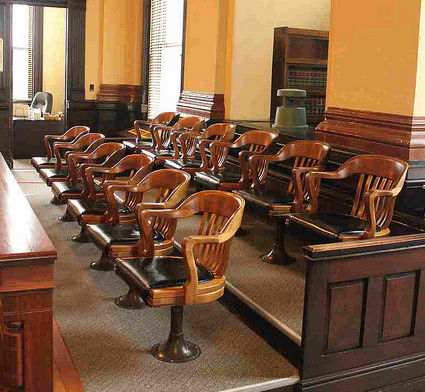
16140571199_fddf693906_z (1)I have been called to jury duty twice, and both times I was released immediately for the mere fact that I am a court reporter, being told I know too much about the legal process and know too many attorneys.  So you can imagine my excitement when I was asked to be a CART (Communication Access Realtime Translation) provider for a hearing-impaired juror.  Not only was it my first opportunity to sit with a jury, but it was also my first murder trial.  Working as a freelance reporter, generally all of my work is civil in nature.

The trial went about as any typical trial does.  Having been an official reporter, I know the things that go on outside of the jury’s presence.  This time, since I was sitting with the juror and none of that was presented to “us,” I found myself envious of the official reporter.  I wanted to hear the bench conferences; I wanted to know why someone in the gallery was asked to leave; I wanted to know why certain witnesses and evidence was not presented; I wanted to know what both sides said about the jury instructions; I wanted to know the “history” of the case.  All things I otherwise would have known as the official reporter.

The case was closed and the time came for deliberations, which is what I was most excited about.  Having not been the CART provider for this particular voir dire selection, I did not know the background of any of the jurors.  I found myself intrigued by all of the different perspectives everyone had, wondering what their background is for them to hold the opinions they did, questioning in my mind why they thought certain things were or weren’t important to the case, and speculating on evidence that was not presented.  It was interesting that everyone heard such different testimony from the same witness.  It was very difficult for me, when they would argue over what was or wasn’t said, to not be able to just pull it up on the screen and show them, as I would do in a deposition setting.

As a freelance reporter, I usually only get to hear one side of the story and I never know the outcome of a case.  So you can imagine my frustration when the outcome ended up being a hung jury!

ABOUT THE AUTHOR:

Rhonda Lawrence is a court reporter with PRI Court Reporting, LLC, in Columbus, Ohio.  You can learn more about Rhonda here.  You can also follow PRI Court Reporting on Twitter and Facebook.

Download the Deposition Scheduling Checklist

  • This field is for validation purposes and should be left unchanged.

Are YOU Your Toughest Competitor?

Are YOU Your Toughest Competitor?

“The individual who only does enough to get by seldom gets much more than “by.” – Napoleon Hill

We’ve all heard the sayings, “You get out what you put in,” or “Garbage in, garbage out,” but this quote that I received in my daily e-mail from the Napoleon Hill Foundation freshened up this principle for me.

If you want to get more than “by,” how about applying these principles to your career, your faith, and your personal relationships in the coming year?  Not a New Year’s resolution, but a commitment to yourself to do your personal best every day.

The phrase that struck me the most in this particular daily e-mail was, “Your harshest critic and your toughest competitor should be you.”  We’re all probably really good at being our own harshest critic, but are we all our toughest competitor?

Do you strive to be/do/think/act better than you did the day before?  Do you seek higher achievements than you did last year?  Do you take the initiative at work to improve a process, make a job easier, save the company money?

Sometimes it’s easy to look at our competitors and try to compete with them when it’s really ourselves that we should be competing with.  If we do that, the achievements we seek will happen because we’re working hard to better ourselves.


ABOUT THE AUTHOR:

Angie Starbuck, RDR, CRR, CRC is a court reporter in Columbus, Ohio, and the owner of PRI Court Reporting, LLC. Connect with her on LinkedIn.  You can also follow PRI Court Reporting on Twitter and Facebook.

Download the Deposition Scheduling Checklist

  • This field is for validation purposes and should be left unchanged.

Lessons Learned – by Angie Starbuck, RPR/CRR

Lessons Learned – by Angie Starbuck, RPR/CRR

As I left the blustery, cold weather of Columbus for the surfer-size waves and sunshine of Laguna Niguel, California, I anticipated all the knowledge I would gain at my first Firm Owners Conference sponsored by the National Court Reporters Association.  Little did I know I would make quick friends with other firm owners across the country and that they would be so willing to share their knowledge and experience to the newcomer.

I learned that a large networking event like Firm Owners can be like speed dating: Introduce yourself, exchange contact information and a little bit about each other, and move on quickly to another new contact.  However, during the keynote speech by Tommy Spalding, author of the New York Times bestseller, “It’s Not Just Who You Know,” I quickly learned that building actual relationships are more important than brief contact and superficial communications.  It was very energizing to hear him talk about truly getting to know someone, building a relationship, and how that can change your heart, change your life, and change your business.

I have many, many take-aways from my first Firm Owners conference, but here are just a few:

Wow, what a successful first Firm Owners Conference!  A huge thank you to Susie, Christy, Dawn B., Chris B., Dawn H., Greg, Shannon, Judy, Michelle, Gail, and Lori for sharing their experiences with me and welcoming me into such a fantastic group of business owners that I am proud to be a part of.


ABOUT THE AUTHOR:

Angie Starbuck, RPR/CRR, is a court reporter in Columbus, Ohio, and the owner of PRI Court Reporting, LLC. Connect with her on LinkedIn and Google+.

Download the Deposition Scheduling Checklist

  • This field is for validation purposes and should be left unchanged.

A Remarkable Evening – by Sara Clark, RPR/CRR/CCP/CBC

A Remarkable Evening – by Sara Clark, RPR/CRR/CCP/CBC

I had the unique opportunity last month to take an assignment for PRI Court Reporting at the 10th anniversary of The New Albany Community Foundation Remarkable Evening event, where former President Bill Clinton was the guest speaker.  PRI was asked to provide an overnight verbatim transcript of the President’s remarks so there could be no possible “misquotations” of him.  I, of course, was beyond thrilled to be asked to cover this job.  After I cleared the required background check (what a relief that was!), I was ready for the big event.

I was asked to arrive three hours prior to the event starting.  When I turned onto Whitebarn Road in New Albany and saw the line of cars – and even buses – waiting to get on the grounds of the Wexner Estate, I knew why I was told to be there at 3:00.

After getting through the gates and making my way past the magnificent horse stables, I was told to follow a man driving a van, where I ended up parking in a hidden area behind a maintenance barn with the rest of “the help,” and I was shuttled back to the Party Barn.  Not quite as glamorous as I had envisioned, but hey, I was there.

I made my way inside and found my contact who showed me where I would be sitting – in the front and slightly off to the side of the stage.  The only thing between me, President Clinton, and Les Wexner was the red velvet rope.  So cool!

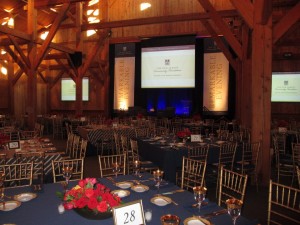
 Wexner party barn 2 Wexner party barn

It was a sold-out crowd of 500 New Albany supporters in the Party Barn, which is an amazing structure with its timber frame construction.  It is by far the most beautiful barn I will ever see.  The guests were wined and dined and some very prestigious awards were given before the President took the stage and talked about his group, The Clinton Foundation, and the work they are doing in Haiti since the devastating earthquake in 2010.  While his speech was intriguing (and challenging because he really got on a roll), the moment that will remain in the forefront of my memory is when he and I made eye contact and exchanged a smile.

Clinton & Wexner
When the applause died down and the President left the building, I was free to pack up and catch the shuttle back to my car.  After seeing my husband and kids for a few minutes before bedtime, I grabbed a quick bite to eat and got back in the saddle and prepared the transcript for the client to see first thing in the morning.

This particular assignment will always be at the top of my list of the most memorable moments in my career.  I’m so proud to be a court reporter!

PRI and OCRA

PRI and OCRA

The Ohio Court Reporters Association (OCRA – NOT pronounced okra) met 3/4/11 through 3/6/11. A good time was had by all. Besides fun we also learned much. A seminar on commas and one on the semicolon, we were in punctuation heaven. The only thing better is when National had an all-day seminar on punctuation. There were good seminars, festivities for all, and Julia from PRI was installed this year again as a district director.  Easton Columbus with OCRA, what better way to spend a rainy weekend?

2010 Certification Update

2010 Certification Update

Continuing to work with the Supreme Court of Ohio and the Ohio Court Reporters Association, Linda Sturm seeks to improve the quality of the profession in Ohio by requiring a rule that all Ohio court reporters be certified. “There are currently no minimum standards for the person charged with writing a verbatim record in a capital murder case or $15,000,000 lawsuit. The person who cuts your hair must be certified. Why not the person responsible for the record? Most attorneys and the public are unaware that court reporters meet zero minimum standards in Ohio. 32 Other states require certification or licensure,” Sturm points out.

Supreme Court of Ohio, Judicial College: A Workshop for Official Reporters of Ohio

Supreme Court of Ohio, Judicial College: A Workshop for Official Reporters of Ohio

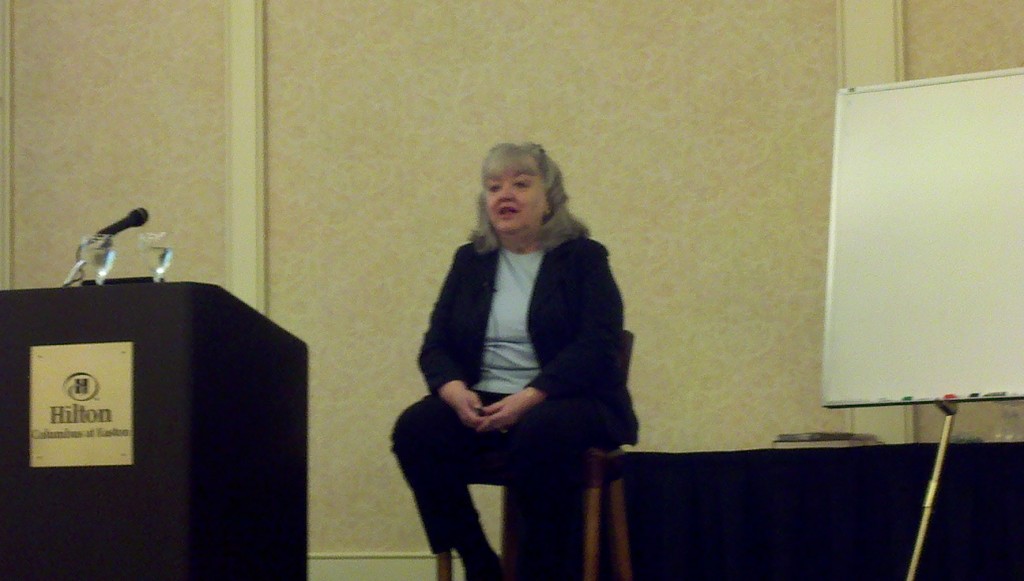
Linda Sturm presented a half-day and full-day seminars for the court reporters working for judges throughout the state of Ohio. Linda shared her knowledge of realtime writing and encouragement to provide realtime in the courtroom.

Top